HOT ROLLED (HR) TRIMMING SCRAP METAL
INDUSTRY GUIDE • PRIME FERROUS SCRAP
Hot Rolled Trimming Scrap Metal: The Complete Guide
What Hot Rolled (HR) trimming scrap is, how it is created, why it is one of the most prized grades in the global steel recycling industry — and how Tiger International Ltd supplies it to steel mills around the world.
Published by Tiger International Ltd • metalscrap.co.uk • 2025
Introduction
In the world of scrap metal, not all material is equal. Scrap can range from heavily contaminated mixed demolition waste at the bottom of the quality ladder all the way up to the cleanest, most consistent prime industrial arisings at the top. Hot Rolled (HR) Trimming Scrap Metal sits firmly at the premium end of that spectrum — and for good reason.
This guide explains everything you need to know about HR trimming scrap: what it is, how and where it is produced, what makes it so valuable to steel mills and electric arc furnaces, how it is traded and exported, and how Tiger International Ltd — operating through metalscrap.co.uk — has become a trusted supplier of this grade to buyers across the globe.
Whether you are a steel mill procurement manager, a scrap metal trader, or simply looking to understand the supply chain behind your steel products, this guide will give you a thorough grounding in one of the UK scrap industry’s most sought-after materials.
| At a Glance
HR Trimming scrap (also known as HR slitter scrap, mandrel wound bundles, side cutting scrap, or bobbin bundles) is a clean, prime-grade ferrous scrap produced directly from the edge-trimming of hot rolled steel coils. It is highly valued by electric arc furnace (EAF) operators worldwide for its purity, consistency, and excellent metallurgical properties. |
What Is Hot Rolled Steel? A Quick Overview
To understand HR trimming scrap, you first need to understand the process that creates it: hot rolling.
Hot rolling is one of the foundational processes in the primary steel industry. It begins with large steel billets or slabs, typically produced from a blast furnace or electric arc furnace, which are reheated to temperatures above 1,700°F (approximately 930°C). At these extreme temperatures, steel becomes highly malleable and workable.
The heated billet is then passed through a series of rolling mill stands — pairs of large powered rollers — which progressively reduce the steel’s thickness and elongate it into long, flat strips. As the strip cools, it is wound onto large mandrels (rotating drums) to form what is commercially known as a hot rolled (HR) coil. These coils can weigh anywhere from 10 to 35 tonnes each, depending on the gauge and width required.
Hot rolled coils are the fundamental semi-finished product that feeds countless downstream manufacturing processes. They are used in the production of automotive body panels, structural steel sections, pipes and tubes, agricultural equipment, ship hulls, white goods, and general fabrication across virtually every industrial sector.
| Key Fact
Steel is classified as ‘hot rolled’ when it is processed above its recrystallisation temperature (typically above 1,700°F / 930°C). Hot rolling produces steel with a characteristic blue-grey mill scale surface finish, excellent formability, and consistent mechanical properties throughout the material. |
What Is Hot Rolled Trimming Scrap?
Once a hot rolled coil has been produced and delivered to a steel service centre or manufacturing facility, it must be processed further to meet the exact dimensional requirements of the end customer. This is where HR trimming scrap is born.
The Slitting and Edge Trimming Process
Hot rolled coils are supplied in standardised widths from the rolling mill — typically ranging from 600mm to over 2,000mm. However, most downstream manufacturers need steel strip in much more specific widths tailored to their particular pressing, forming, or welding processes.
To achieve this, coils are processed through de-coiling and edge trimming centres, also known as slitting lines. These machines uncoil the steel strip, pass it through precision rotary slitting blades, and recoil the resulting narrower strips. The outer edges of the strip — which may be slightly irregular, oxidised, or simply beyond the required width — are trimmed off by the slitting blades.
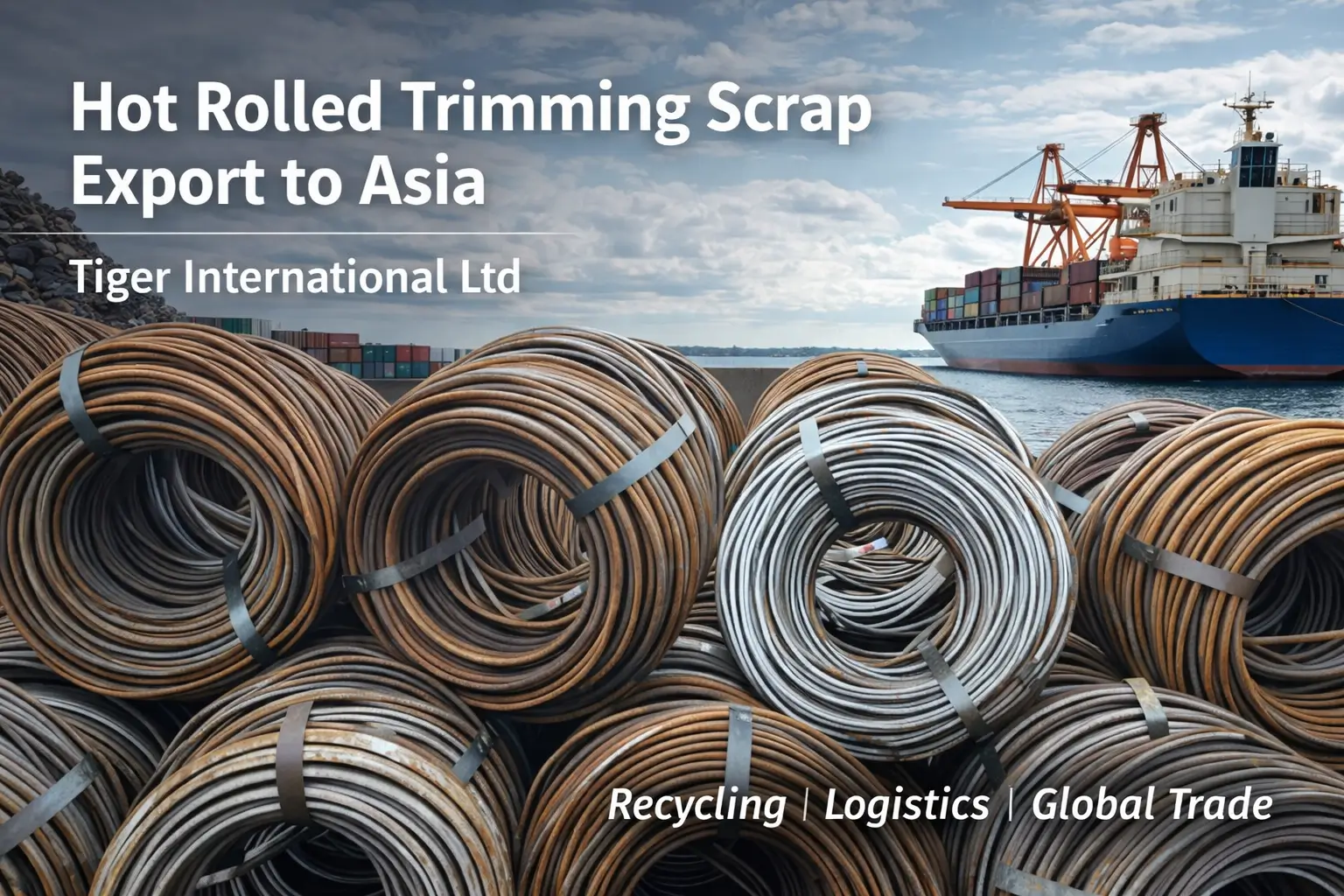
These trimmed edge strips are the material known as HR Trimming Scrap. Because the original coil was wound in a circular reel, and the trimmings are cut continuously as the coil is unwound, the resulting scrap naturally reverts to a coil or reel shape after cutting. This distinctive circular, wound form is one of the key visual identifiers of HR trimming scrap and is why it is also commercially referred to as mandrel wound bundles, bobbin bundles, or skelp reels.
| Process Summary
Hot rolled coil → De-coiling at slitting line → Rotary blade edge trimming → Slit coils (product) + Edge trimming offcuts (HR Trimming Scrap). The scrap is a direct by-product of precision coil processing — clean, new, and generated in consistent volumes wherever steel service centres operate. |
Other Names for HR Trimming Scrap
HR Trimming scrap is known by several names in the industry, all referring to the same material:
- HR Trimming Scrap — the most common commercial description
- HR Slitter Scrap — referring to its origin at a steel slitting line
- Mandrel Wound Bundles — reflecting the coiled/wound shape of the material
- Bobbin Bundles — another reference to the bobbin-like wound form
- HR Side Cutting Scrap — describing the edge-cutting process
- Skelp Reels — an older term sometimes used in the UK and North American markets
- 1 Bundles (in some classification systems) — when meeting prime bundle scrap specifications
Why Is HR Trimming Scrap So Valuable?
Not all ferrous scrap is created equal. HR trimming sits at the premium end of the ferrous scrap grading system for a number of compelling reasons:
1. Exceptional Cleanliness and Purity
HR trimming is new industrial scrap — it has never been in service, never been painted, coated, welded, or contaminated with non-ferrous metals. It comes directly from a controlled industrial process with a known, consistent input material (hot rolled steel coil). This means it is essentially free from the tramp elements — copper, tin, lead, zinc — that contaminate obsolete scrap grades like shredded auto scrap or demolition material.
The presence of tramp elements, particularly copper and tin, is one of the steel industry’s biggest recycling challenges. Even tiny concentrations can cause surface cracking during hot rolling of recycled steel. HR trimming scrap effectively eliminates this risk entirely.
2. Consistent Metallurgical Specification
Because HR trimming originates from a defined, documented product — hot rolled carbon steel coil to a known specification — buyers know exactly what chemistry they are receiving. Carbon content, yield strength, tensile strength, and ductility are all predictable. This makes charge calculation for electric arc furnaces significantly simpler and more reliable compared to mixed or obsolete scrap grades.
3. High Ductility and Strength
Hot rolled steel is characterised by its combination of high strength and excellent ductility — the ability to deform without fracturing. These properties are preserved in the trimming scrap, making it not just suitable for re-melting, but also in some cases directly usable in cold drawing processes for wire and tube production without further steelmaking.
4. Ideal for Electric Arc Furnace (EAF) Charging
The global steel industry is increasingly shifting toward electric arc furnace (EAF) steelmaking as part of decarbonisation strategies. EAFs require high-quality, low-residual scrap to produce premium steel products. HR trimming scrap is one of the most EAF-compatible grades available — its coiled form charges efficiently, melts consistently, and introduces no unwanted chemistry into the heat.
5. Excellent Bulk Density and Handling Characteristics
The wound, coiled form of HR trimming scrap gives it a relatively high bulk density compared to loose or shredded scrap. This means more steel tonnage fits into a container or bulk vessel, reducing per-tonne logistics costs for both sellers and buyers. The coiled form also handles cleanly with electromagnets and cranes, minimising handling time at both origin and destination.
| Industry Classification
Under the ISRI (Institute of Scrap Recycling Industries) scrap specification system, HR trimming scrap closely aligns with the No. 1 Bundles grade — described as new black steel sheet scrap, clippings or skeleton scrap, free of coated material, and including mandrel wound bundles and skeleton reels. This is one of the highest-value prompt industrial scrap classifications. |
Where Is HR Trimming Scrap Generated?
HR trimming scrap is what the industry classifies as ‘prompt’ or ‘industrial’ scrap — material arising directly from manufacturing processes, as opposed to end-of-life (obsolete) scrap recovered from products at the end of their useful life.
The primary generators of HR trimming scrap in the UK and globally include:
- Steel service centres — companies that purchase standard hot rolled coils and process them to customer-specific widths for onward supply to manufacturers. These are typically the largest and most consistent generators of HR trimming scrap.
- Automotive stamping plants — car body manufacturing relies heavily on precisely slit steel strip. Edge trimmings from automotive coil processing represent a significant and very clean scrap stream.
- Pipe and tube manufacturers — the production of welded steel pipe requires strip steel slit to exact widths. The edge trimming from this process is a valuable HR scrap arising.
- Construction product manufacturers — manufacturers of roofing, cladding, purlins, and structural products often process HR coils, generating consistent trimming offcuts.
- White goods and appliance manufacturers — washing machines, refrigerators, and similar products are manufactured from precisely dimensioned steel strip, producing regular scrap arisings.
- General metal fabricators and presswork shops — a wide range of engineering and fabrication businesses generate HR trimming scrap as part of their coil processing operations.
In the UK, the concentration of steel service centres and coil processing facilities in the Midlands, Yorkshire, and the North West creates a dense supply of HR trimming scrap available to experienced traders like Tiger International Ltd.
Tiger International Ltd: Supplying HR Trimming Scrap to the World
Tiger International Ltd, trading through metalscrap.co.uk, has built its reputation in part on its expertise in sourcing, handling, and exporting HR trimming scrap to steel mills across Asia and beyond. This is not a commodity Tiger International stumbled upon — it is a specialisation developed through years of supply chain development and trading relationships.
A Long-Standing UK Supply Network
The quality and consistency of HR trimming scrap supply depends critically on access to reliable, established generators. Tiger International has developed long-standing partnerships with steel service centres, coil processing facilities, and manufacturing operations across the UK — relationships built over years on the basis of fair pricing, reliable collection, and professional, compliant operation.
These are not spot-bought loads of uncertain origin. Tiger International’s UK supply base represents verified, documented sources of prime HR trimming scrap, with consistent specification and predictable volumes. This supply chain depth is what allows Tiger International to commit to export contracts with confidence and to deliver against buyer requirements consistently, shipment after shipment.
Export Operations and Containerisation
HR trimming scrap is typically exported in 20-foot standard ocean containers. Thanks to its coiled, wound form and relatively high bulk density, well-loaded containers can accommodate between 20 and 24 metric tonnes of HR trimming scrap per container — maximising freight efficiency for the buyer.
Tiger International works with experienced freight forwarding partners to ensure efficient containerisation, port booking, and vessel selection. The company’s operations are aligned with the UK’s major container port infrastructure, including Tilbury, Felixstowe, and Southampton, enabling competitive routing to virtually any global destination.
Key Export Markets
Tiger International exports HR trimming scrap to steel mills and foundries across the globe. Key markets include:
- Asia — EAF steel mills in countries including Bangladesh, Pakistan, India, Vietnam, Malaysia, and Indonesia are major consumers of UK prime scrap. HR trimming is particularly sought after for its ability to meet the quality thresholds required for flat-rolled and engineering steel production in these markets.
- Turkey — The world’s largest ferrous scrap importer, Turkey’s EAF-dominated steel sector has an ongoing appetite for prime quality grades. HR trimming commands a consistent premium over standard HMS grades in Turkish mill pricing.
- Middle East — Developing steel industries in the Gulf region, particularly in UAE and Saudi Arabia, are increasingly importing quality UK ferrous scrap to support domestic manufacturing growth.
- Europe — When pricing and logistics align, Continental European EAF mills also source UK HR trimming scrap, particularly for high-grade flat-rolled production.
Regulatory Compliance
The export of scrap metal from the United Kingdom is subject to UK REACH regulations, Environment Agency waste carrier licensing requirements, and — for certain shipments to non-OECD countries — prior notification procedures under UK waste shipment regulations. Tiger International maintains full regulatory compliance across all its export activities, providing buyers with the confidence and documentation certainty they need for smooth customs clearance at destination ports.
All shipments are accurately classified under the relevant HS tariff codes (Chapter 72 — ferrous scrap), supported by accurate waste shipment documentation, commercial invoices, packing lists, and port health certificates as required by destination country regulations.
Hot Rolled Trimming Scrap: Market Dynamics and Pricing
How HR Trimming Is Priced
HR trimming scrap is priced relative to prevailing global ferrous scrap benchmarks — primarily the HMS (Heavy Melting Scrap) 1&2 composite index and the No. 1 Busheling / prime bundle price published by services such as Steel Market Update, Platts, and Argus Ferrous Markets. HR trimming consistently commands a premium over HMS 1&2 grades, reflecting its superior cleanliness, consistent chemistry, and lower processing cost for EAF operators.
In practice, this premium typically ranges from £15 to £50 per metric tonne over HMS equivalent pricing, depending on market conditions, origin, cleanliness certification, and volume. In tighter prime scrap markets — when automotive production is high and prompt scrap arisings are constrained — this premium can widen significantly.
Key Price Drivers
Several factors influence HR trimming scrap prices at any given time:
- Global steel production levels — higher steel output increases EAF scrap demand and supports prime scrap premiums.
- Automotive production volumes — the automotive industry is one of the largest generators and consumers of prime scrap; downturns compress supply and push prices for available material higher.
- Turkish import tender prices — Turkey’s regular scrap import tenders set a global benchmark that influences export valuations from the UK and Europe.
- Shipping and container freight rates — container logistics costs directly affect the delivered cost economics for importing steel mills.
- UK domestic steel demand — when UK mills compete more actively for prime scrap, export premiums must rise to attract material away from the domestic market.
- Currency movements — the GBP/USD and GBP/EUR exchange rates affect the competitiveness of UK-origin scrap in global markets.
| Market Context (2025)
The global scrap metal recycling market continues to show resilience in 2025, with ferrous scrap demand underpinned by the ongoing expansion of EAF-based steelmaking globally. Prime grades including HR trimming remain structurally undersupplied relative to demand as EAF capacity growth outpaces the increase in prime prompt scrap generation — a dynamic that supports sustained pricing premiums for clean industrial grades. |
HR Trimming Scrap and the Circular Economy
Hot rolled trimming scrap represents perhaps the purest expression of the circular economy in the steel industry. It is new material, barely used, repurposed at minimal cost. There is no complex sorting, no contamination to remove, no degradation of the original steel — it goes back into the furnace and emerges as new steel product with effectively no loss of material quality.
Steel is infinitely recyclable — this is one of its most remarkable properties. Every tonne of HR trimming scrap recycled through an EAF displaces approximately 1.5 tonnes of CO₂ compared to producing an equivalent tonne of virgin steel via the blast furnace route. For the steel industry — one of the world’s most significant industrial CO₂ emitters — access to clean, high-quality prompt scrap like HR trimming is not merely commercially convenient; it is strategically essential to the sector’s net-zero transition.
Tiger International is proud to play a role in this global material flow. By efficiently channelling UK industrial prompt scrap — material that might otherwise sit idle or be downgraded — to EAF steel mills in Asia and elsewhere, the company contributes directly to the decarbonisation of global steel production and the advancement of the circular economy.
| Sustainability Fact
Recycling one tonne of steel via EAF using prime scrap like HR trimming uses approximately 75% less energy than producing an equivalent tonne of virgin steel from iron ore in a blast furnace. Clean, prime scrap grades are the enablers of truly low-carbon steelmaking. |
Buying Hot Rolled Trimming Scrap from Tiger International
If you are a steel mill, foundry, or metals trader looking to source consistent volumes of UK HR trimming scrap, Tiger International offers a straightforward and professional procurement process:
Step 1: Enquiry
Contact Tiger International via metalscrap.co.uk with your target specification, required volume, preferred shipping terms (FOB, CIF, CFR), and destination port. Our trading team will respond promptly with current availability and an indicative price.
Step 2: Commercial Agreement
Once indicative terms are agreed, we will issue a formal Sales Contract covering material specification, weight, price, loading port, payment terms, and delivery schedule. New buyers typically trade on irrevocable Letter of Credit (LC) at sight terms.
Step 3: Loading and Inspection
Material is containerised at our agreed loading facility, with weights certified by a licensed weighbridge. Pre-shipment inspection by independent agencies (SGS, Bureau Veritas, Intertek) is available and welcomed. Shipping documents are prepared and issued promptly upon vessel departure.
Step 4: Ongoing Supply
Tiger International’s supply relationships are built for consistency. Once an initial trade is completed satisfactorily, we work proactively to maintain regular supply schedules, offering market price updates and advance notice of availability changes — the kind of supply chain visibility that mills need for confident production planning.
Conclusion
Hot rolled trimming scrap metal is one of the cleanest, most consistent, and most commercially valuable grades of ferrous scrap in the global recycling industry. Generated directly from the precision processing of new hot rolled steel coils, it is free from contamination, metallurgically reliable, and perfectly suited to the growing EAF steelmaking sector that is driving the industry’s decarbonisation.
For buyers seeking a dependable UK-origin supply of HR trimming scrap — material with known chemistry, clean specification, and reliable volume — Tiger International Ltd represents a proven and trusted partner. Our long-standing UK supply partnerships, containerisation expertise, export compliance capability, and commitment to professional, long-term trading relationships make us the natural choice for steel mills and traders who value consistency as much as price.
Explore our full range of ferrous scrap grades at metalscrap.co.uk, or contact our trading team today to discuss your HR trimming requirements.