INDUSTRY INSIGHT • SCRAP METAL EXPORTS
UK Train Wheel & Axle Scrap Metal Exports: The Complete Guide
How Tiger International Ltd is supplying the world with premium UK railway scrap — backed by long-standing partnerships, verified supply chains, and decades of export expertise.
Published by Tiger International Ltd • metalscrap.co.uk • March 2025
Introduction: A Specialist Material in High Global Demand
The United Kingdom’s railway network is one of the oldest and most extensive in the world. With thousands of locomotives, passenger carriages, freight wagons, and metro units continuously in service — and an ongoing programme of rolling stock renewal — the UK generates a significant and consistent stream of train wheel and axle scrap metal every year.
This material is far from ordinary scrap. Train wheels and axles are precision-engineered components manufactured from high-grade carbon steel and alloy steel, making them highly sought after by steel mills, foundries, and metal processors across the globe. For international buyers, sourcing UK railway scrap means accessing metallurgically superior material with a proven circular economy value.
At Tiger International Ltd — trading through metalscrap.co.uk — we have built our reputation on connecting this premium UK supply with buyers worldwide. Our long-standing network of UK suppliers, combined with our global trading relationships, positions us uniquely as a trusted partner for consistent, competitively priced railway scrap metal exports.
| Key Stat
The UK scrap metal recycling industry generates an estimated £8.7 billion in revenue annually (IBISWorld, 2025), with ferrous scrap — including railway steel — forming a substantial pillar of export volumes. |
What Are Train Wheel & Axle Scrap Metal?
Before examining the market, it helps to understand precisely what this material is — both in terms of physical composition and commercial classification.
Train Wheels (Monobloc & Tyred)
Modern railway wheels are almost universally manufactured as monobloc (single-piece) castings, machined from solid billets of high-carbon steel. A standard mainline wheel typically weighs between 300 kg and 500 kg depending on the rolling stock type. Wheels are initially cast or forged, then heat-treated to achieve a specific hardness profile that withstands the enormous forces of rail operation.
Older or heritage stock may feature tyred wheels — a steel wheel core with a separate steel tyre (rim) pressed and shrunk onto the outer edge. Both types, once decommissioned, represent a concentrated and clean source of steel scrap with high metallurgical value.
Axles
Railway axles are manufactured from medium-carbon or alloy steel forgings, designed to withstand extreme fatigue loads over millions of wheel rotations. A standard freight axle can weigh upwards of 200–350 kg. The steel specification used in axles — typically to EN 13261 or equivalent British Standards — makes this material particularly attractive for re-melting into new engineering steels.
Wheelsets
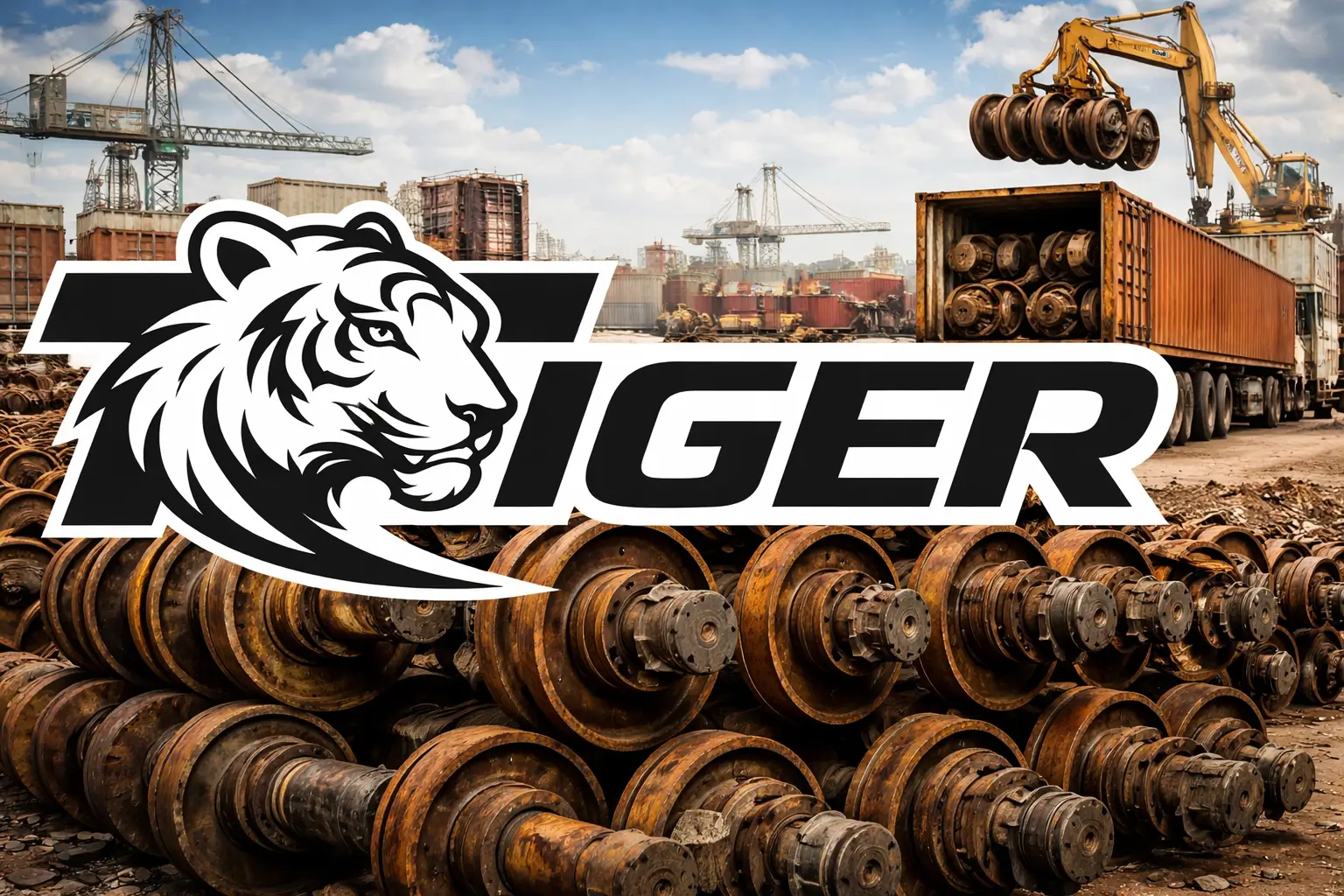
A wheelset — two wheels press-fitted onto a common axle — is the standard unit in which railway wheels and axles are encountered when rolling stock is scrapped. Each passenger coach typically carries four wheelsets. A freight locomotive may carry up to eight or more. When a train is retired, the wheelsets are removed during dismantling and represent a priority scrap stream due to their weight concentration and material quality.
| Material Note
Railway wheels and axles are primarily composed of high-carbon steel (approximately 0.5–0.8% carbon content) and alloy steels. This makes them ideal feedstock for electric arc furnaces (EAF) producing engineering-grade steels — commanding a premium over general heavy melting scrap (HMS). |
Why the UK is a Major Source of Railway Scrap
The United Kingdom has several structural advantages that make it one of the world’s most reliable sources of train wheel and axle scrap metal:
1. Extensive & Ageing Fleet Renewal Programme
Network Rail and the UK’s train operating companies are engaged in a sustained programme of fleet modernisation. The retirement of older Class 150, 158, 170, and various locomotive-hauled coaching stock is generating considerable volumes of scrap wheelsets and bogies. Each generation of fleet replacement adds new feedstock into the UK scrap supply chain.
2. London Underground & Metro Systems
The London Underground operates one of the densest urban rail networks in the world. The ongoing replacement of older tube stock — including the Piccadilly line upgrade and Bakerloo line renewal — generates dedicated volumes of metro-spec wheel and axle scrap. Similar volumes arise from Tyne & Wear Metro, Glasgow Subway, and light rail systems across Birmingham, Manchester, and Nottingham.
3. Freight Sector Scrapping
The UK freight rail sector — operated by companies including DB Cargo UK, Freightliner, GBRf, and Colas Rail — continuously cycles out older wagons and locomotives. Freight wheelsets are typically heavier than passenger equivalents, with axle loads designed to carry up to 25 tonnes per axle. This generates high-density, premium scrap material.
4. Heritage Railway Sector
The UK’s vibrant heritage and preserved railway community — encompassing over 100 active lines — also contributes to the scrap stream as irreparable components from steam and early diesel era stock are retired. While much is preserved, worn and beyond-repair wheels and axles enter the commercial scrap market.
5. Established Industrial Infrastructure
The UK benefits from mature scrap processing infrastructure including shredders, baling presses, and torch-cutting facilities located near major ports (Tilbury, Southampton, Immingham, Liverpool). This allows efficient preparation of railway scrap to internationally accepted specifications such as ISRI grades or bespoke buyer requirements.
The Global Market for Railway Scrap Metal
Demand for UK railway scrap — including wheel and axle material — is genuinely global. Steel mills and foundries across multiple continents actively seek this grade of material as part of their raw material procurement strategies.
Key Import Markets
- Turkey — The Turkish electric arc furnace (EAF) steel sector is the world’s largest consumer of ferrous scrap. Turkish mills import millions of tonnes of steel scrap annually from the UK and Europe, with railway steel attracting premiums over standard HMS grades.
- India — India’s rapidly expanding steel sector, with a stated ambition to produce 300 million tonnes of crude steel annually by 2030, has an insatiable appetite for high-quality scrap. Indian foundries and re-rolling mills specifically value clean, segregated railway wheel and axle material.
- Bangladesh & Pakistan — Both nations operate large ship-breaking and steel re-rolling industries. Railway scrap is imported in container and bulk shipments, processed locally, and re-entered into the domestic steel supply chain.
- South East Asia (Malaysia, Vietnam, Indonesia) — Growing steel sectors in these markets increasingly source specialist scrap grades from the UK. The region’s shift toward EAF-based steelmaking is accelerating demand for premium ferrous scrap.
- Middle East — UAE-based and Saudi Arabian steel producers are emerging importers of quality UK scrap as they build out domestic manufacturing capacity in line with Vision 2030 and comparable programmes.
- Europe — Continental European mills, particularly in Spain, Italy, and Eastern Europe, also import UK railway scrap when logistics and price conditions are favourable, particularly for specialist alloy wheel material.
| Market Context
The global rail wheel and axle market itself was valued at approximately USD 4.9 billion in 2024 and is projected to exceed USD 6.9 billion by 2030 (CAGR ~5.86%). As new wheelsets replace old ones, the corresponding scrap volumes will continue to grow in parallel with global fleet expansion. |
Tiger International Ltd: Exporting UK Railway Scrap to the World
Tiger International Ltd, operating through metalscrap.co.uk, is a specialist UK scrap metal trading company with a proven track record in sourcing, processing, and exporting ferrous and non-ferrous scrap from the United Kingdom to international buyers.
Long-Standing UK Supply Partnerships
One of Tiger International’s most significant competitive advantages is the depth and longevity of its UK supply network. Over many years of operation, the company has built and maintained long-standing relationships with:
- Train operating companies (TOCs) and their engineering subsidiaries
- Rolling stock maintenance depots and heavy maintenance facilities
- Rail infrastructure contractors and Network Rail approved dismantlers
- UK scrap merchants and metal recyclers handling railway arisings
- Industrial demolition contractors working on decommissioned rail infrastructure
These relationships are not transactional — they are partnerships built on reliability, fair pricing, regulatory compliance, and consistent collection. This supply base continuity means Tiger International can commit to export contracts with confidence, offering buyers the assurance of regular, uninterrupted material flow.
Export Capabilities & Logistics
Tiger International has established freight forwarding and shipping relationships that enable flexible export logistics for railway scrap material. Whether a buyer requires containerised loads of processed wheelset pieces, bulk vessel shipments of mixed railway ferrous scrap, or specific tonnage parcels of segregated wheel or axle material, the company has the operational capacity to fulfil requirements.
The UK’s extensive port infrastructure — including deep-water facilities at Tilbury, Southampton, Felixstowe, Immingham, and Liverpool — allows cost-effective routing to virtually any global destination. Tiger International works with experienced freight partners to optimise routing, documentation, and compliance at every stage of the export process.
Regulatory Compliance & Documentation
The export of scrap metal from the UK is governed by UK REACH regulations, Environment Agency licensing requirements, and, where applicable, Basel Convention controls on waste shipments. Tiger International maintains full regulatory compliance across all export activities, providing buyers with the documentation certainty required for smooth customs clearance in destination markets.
All material is accurately described, classified under the correct commodity codes (HS Chapter 72 for ferrous scrap; HS 8607 for railway-specific components), and supported by the required waste shipment notifications, port health certificates, and letters of credit where applicable.
Consistent Quality Standards
Railway wheel and axle scrap from Tiger International’s supply base is typically supplied as:
- Unsorted wheelsets — complete wheelsets available for torch-cutting at destination
- Cut and processed railway wheels — torch-cut to buyer specification, typically 500mm x 500mm pieces
- Clean axle material — cut axle sections, free from bearings and extraneous material
- Mixed railway bogie scrap — includes wheelsets, bogie frames, and associated steel components
- Segregated high-carbon wheel steel — premium grade for specialist foundry use
Sustainability & the Circular Economy
The export of UK train wheel and axle scrap metal is not only commercially valuable — it is an essential contribution to the global circular economy and the decarbonisation of the steel industry.
Steel is infinitely recyclable without loss of material properties. Every tonne of railway scrap exported by Tiger International displaces the need for virgin iron ore mining and primary steelmaking, saving approximately 1.5 tonnes of CO₂ per tonne of steel recycled compared to blast furnace production. For high-carbon railway steel — which requires significant energy to produce in virgin form — this saving is particularly significant.
The Lucchini Group, one of Europe’s largest railway wheel manufacturers, has publicly committed to its ‘Reduce, Re-use, Recycle’ philosophy, noting that steel scrap forms a critical part of the raw material input for new wheel production. UK-exported railway scrap therefore literally becomes the next generation of train wheels — a powerful circular economy story.
For buyers in markets like Turkey and India, where EAF-based steelmaking is dominant, UK railway scrap provides the high-quality ferrous raw material that enables them to produce new steel products with a significantly reduced carbon footprint relative to blast furnace alternatives. Tiger International is proud to be part of this global sustainability chain.
| Environmental Fact
Recycling steel scrap in an electric arc furnace uses approximately 75% less energy than producing steel from iron ore via a blast furnace. By exporting UK railway scrap, Tiger International directly supports the decarbonisation of global steel manufacturing. |
Commercial Considerations for Buyers
Pricing
Train wheel and axle scrap is priced relative to the prevailing London Metal Exchange (LME) steel scrap indices and the global HMS (Heavy Melting Scrap) benchmark prices, typically attracting a premium of £10–£40 per tonne over standard HMS 1&2 grades, depending on the cleanliness of the material, carbon content certification, and volume committed.
Minimum Order Quantities
Tiger International can accommodate a range of order sizes. Container loads (typically 20–22 tonnes) are available for buyers requiring smaller parcels. Full bulk vessel cargoes (5,000 – 25,000+ tonnes) can be arranged for large-volume purchasers with established relationships and appropriate financial instruments in place.
Payment Terms
Standard payment terms for new buyer relationships are by irrevocable Letter of Credit (LC) at sight. Established buyers with a proven trading history may be accommodated on alternative arrangements. Tiger International works with experienced trade finance professionals to facilitate smooth transaction processing across all major currencies.
Inspection & Certification
Independent pre-shipment inspection by internationally recognised inspection agencies (SGS, Bureau Veritas, Intertek) is available and encouraged. Tiger International welcomes buyer inspection and will cooperate fully with survey requirements prior to shipment.
Why Choose Tiger International Ltd?
There are many scrap metal traders in the UK. Here is what sets Tiger International apart when it comes to railway wheel and axle scrap exports:
- Established UK supply base — Years of relationship-building means consistent access to genuine railway scrap arisings, not spot-bought material of uncertain provenance.
- Specialist knowledge — We understand the metallurgical specifications buyers require and can advise on material quality, composition, and suitability for specific end uses.
- Export compliance expertise — Full regulatory knowledge across UK export law, waste shipment regulations, and international trade documentation.
- Flexible logistics — Port-of-choice flexibility, container and bulk vessel capability, and experienced freight forwarding partners worldwide.
- Long-term partnership approach — We are not focused on one-off transactions. We build trading relationships designed to deliver mutual value over the long term.
- Transparent pricing — Market-linked pricing with clear methodology. No hidden charges. No surprises.
- Responsive communication — International trading requires fast, clear communication across time zones. Our team is committed to responsive, professional engagement.
How to Work With Tiger International Ltd
Getting started with Tiger International is straightforward. Whether you are an established importer looking for a new reliable UK supplier, or exploring UK railway scrap for the first time, we welcome your enquiry.
Step 1: Initial Enquiry
Contact Tiger International Ltd via www.metalscrap.co.uk, by email, or by telephone. Provide us with your target material specification, volume requirements, preferred delivery terms (FOB, CIF, CFR), and intended port of discharge.
Step 2: Offer & Negotiation
Our trading team will respond promptly with a competitive indication price. We are experienced in negotiating commercially viable terms for both parties and will work constructively to agree a price and contract structure that works for you.
Step 3: Contract & Financial Instrument
Once commercial terms are agreed, we will issue a formal Sales Contract. New buyers are requested to open an irrevocable LC in favour of Tiger International Ltd. We will guide you through the documentation requirements.
Step 4: Loading & Shipment
Material is prepared, inspected (if required), loaded, and shipped in accordance with the agreed schedule. Full shipping documents — including Bill of Lading, packing list, weight certificates, and export declarations — are provided promptly.
Step 5: Ongoing Partnership
Our goal is not a single transaction but a long-term supply relationship. We will keep you informed of UK railway scrap availability, pricing movements, and new opportunities as they arise.
Conclusion
UK train wheel and axle scrap metal represents one of the most commercially attractive and metallurgically consistent grades of ferrous scrap available from the British market. Driven by the UK’s fleet renewal programmes, the depth of its railway infrastructure, and its mature recycling industry, the supply of this premium material is ongoing and growing.
Tiger International Ltd is uniquely positioned to connect this quality UK supply with international buyers who demand consistency, compliance, and commercial expertise. Our long-standing UK partnerships, global trading reach, and deep specialist knowledge of railway scrap make us the partner of choice for buyers across Turkey, India, South East Asia, the Middle East, and beyond.
If you are looking for a reliable, experienced UK railway scrap exporter — one that understands your needs, can deliver consistently, and will treat you as a long-term partner — we invite you to get in touch today.